Table of Contents
Learn how to build a text marketing strategy with useful SMS marketing campaigns, stronger opt-in flows and messages customers want to receive.
Most people do not mind receiving text messages from a business. They mind receiving messages that waste their time.
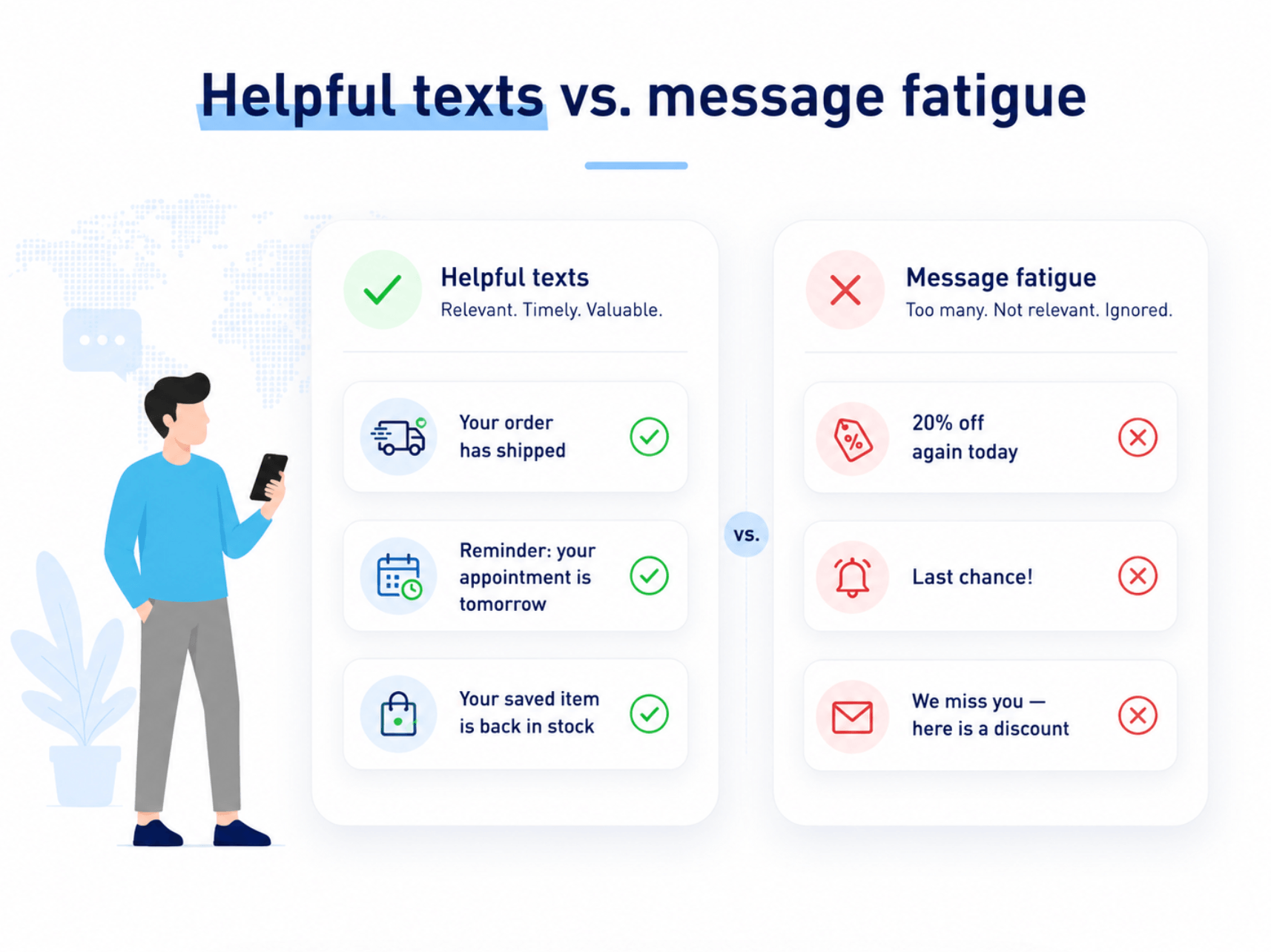
A delivery update that arrives at the right moment is useful. A reminder before an appointment can save a missed booking. A back-in-stock alert can feel like good service. But a generic discount sent every Friday soon becomes background noise, even for customers who once opted in.
That is the real challenge with SMS marketing. The channel is direct, immediate and hard to ignore. That gives every message more weight.
This guide explains how text marketing fits into the customer journey, which campaign moments deserve a text and how to create an SMS marketing strategy that feels useful instead of intrusive.

Test SMSAPI
Create a free account at SMSAPI and test the professional SMS gateway for companies.
What is text marketing?
Text marketing is the use of SMS messages to communicate with customers and prospects who have agreed to receive them. Businesses use text messages for promotions, product updates, reminders, delivery notifications, account alerts and customer service.
You may also see it described as text message marketing, SMS marketing or a short message service campaign. The principle stays the same: a business sends a concise message to a customer’s phone number, usually with a clear action or update.
The best text marketing does not treat every person on an SMS list as part of the same audience. It uses timing, context and customer behaviour to send messages that make sense for the recipient.
That distinction matters. An SMS message sits next to messages from friends, family, banks and delivery companies. It has to earn its place there. For a broader overview of the foundations, see SMSAPI’s guide to business SMS messaging.
Why SMS marketing still matters
Email marketing gives businesses more room for detail. Social media can create discovery and community. SMS marketing works best when the message needs attention soon.

What are the applications of business text messages?
Transactional and operational
- one-time passwords and two-factor authentication
- order and payment confirmations
- delivery notifications
- appointment reminders
- access codes and check-in details
- subscription renewal reminders
- staff and internal alerts
Marketing
- time-limited promotions and flash sales
- back-in-stock alerts
- event reminders and invitations
- reactivation campaigns for inactive customers
- review and satisfaction requests
A good text marketing platform helps teams coordinate these moments instead of treating every message as a bulk SMS blast.
SMSAPI supports bulk SMS for scheduled campaigns as well as API-led messaging for triggered communications. That means a team can run a promotion while automating transactional updates from its CRM, ecommerce platform or internal system.
Text marketing is not only promotional
Many SMS marketing campaigns fail before they start because they rely on one type of message: the offer. Discounts are useful in the right context. They are not a complete marketing strategy.
A stronger marketing program uses SMS across moments that already matter to the customer. Think about the difference between these two sequences.
Sequence one:
- 15% off this weekend
- 20% off today
- Last chance for 20% off
- You have not shopped in a while. Here is 15% off
Sequence two:
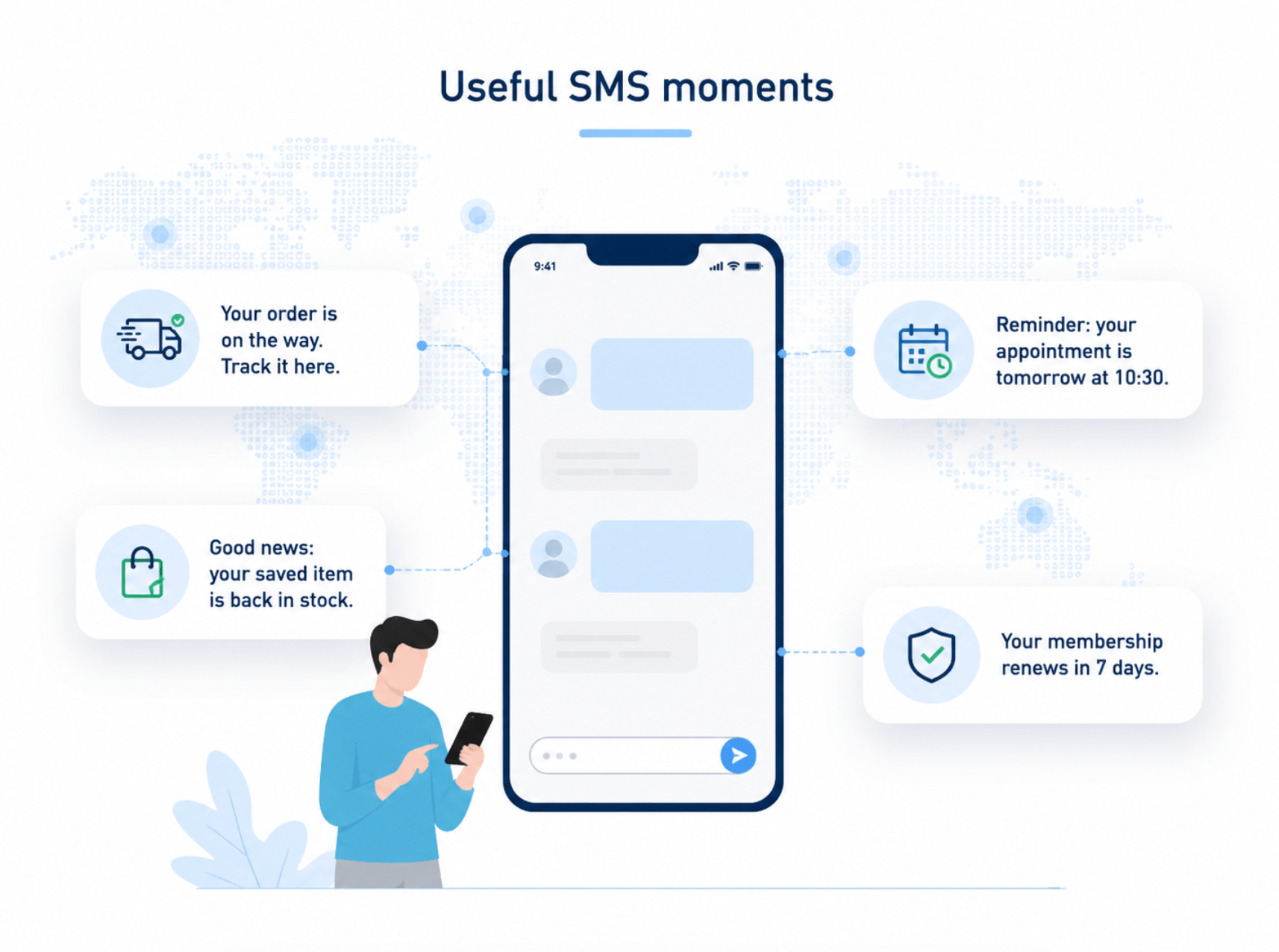
- Your order has been confirmed
- Your delivery is due tomorrow
- The item you saved is back in stock
- Your annual service is due next month
- Your membership renews in seven days
- Here is an offer relevant to the category you bought before
The second sequence uses text messages as part of customer communication, not a megaphone. For ecommerce teams, SMS for online stores is a useful reference point because it covers the mix of transactional notifications, promotional campaigns and service messages that can support the purchase journey.
The customer lifecycle moments that work best for SMS
1. Sign-up and first purchase
The first message after opt-in should set expectations. Confirm what the customer agreed to receive. Mention the brand name. Tell them how to opt out. Then give them a reason to stay subscribed.
For an ecommerce store, that could be early access to restocks or occasional product alerts. For a local service business, it may be reminders and booking updates. For a subscription business, it could be account information and relevant renewal messages.
Do not rush into a complicated automated text sequence before you know what customers actually value. Start with one useful welcome message, then build from there.
When a business needs to connect SMS to sign-up forms, CRM activity or customer data, SMS API integrations can help define how the systems exchange the right information.
2. Order, delivery and post-purchase updates
Order updates are not always classified as SMS marketing, but they can shape how customers feel about a brand. A clear confirmation removes uncertainty. A delivery alert reduces missed parcels. A follow-up message can ask for feedback after the product arrives. For example: Your order is on its way and should arrive tomorrow. Track it here: [link]. That message does not need a sales pitch. It has one job.
After the delivery, the business can decide if a follow-up makes sense. A beauty brand might send routine tips. A homewares store could share care instructions. A service provider may invite the customer to book the next appointment. The message should build on what the customer has already done.
SMSAPI’s ecommerce messaging guide is useful here because it separates transactional communication from promotional messaging instead of treating every SMS as an offer.
3. Appointment reminders
Texting is particularly useful when a missed appointment creates cost for both the customer and the business.
Salons, clinics, garages, fitness studios, estate agencies and professional services can automate reminders before a booking. A short reminder can include time, location and a simple route to reschedule. For example: Reminder: your appointment with Green Street Dental is tomorrow at 10:30. Need to change it? Reply or use this link: [link].
This is a practical example of how to use SMS with no need for a promotional message. It also gives the customer a clear action before a no-show becomes a problem. Businesses that need replies and rescheduling can build on two-way SMS communication instead of treating every message as one-way delivery.
4. Back-in-stock and price-drop alerts
A customer who asks to be notified about a product has already shown intent. That makes back-in-stock campaigns one of the clearest uses of text marketing. The message should stay specific: Your saved navy jacket is back in stock in size M. Shop here: [link]. A vague message such as “New products are waiting” loses the advantage of the original request.
For price drops, take care with timing. Customers who bought the same item two days earlier may not appreciate an alert that makes them feel they paid too much. A good SMS marketing platform should make it easier to segment who receives which campaign.
For stores using Shopware, SMSAPI’s Shopware SMS messaging plugin includes automation ideas such as restock notifications and abandoned checkout recovery.
5. Renewal and expiry reminders
Some products and services have a natural renewal point: insurance, subscriptions, memberships, prescription refills, licences, annual checks or recurring services. These messages are useful because they reduce the chance that the customer forgets something important.
A renewal reminder should explain what happens next, not create panic: Your membership renews on 15 September. Update your payment details or review your plan here: [link]. This is also a good place to connect SMS with email. The SMS can serve as a short reminder, while email provides the full detail.
A mixed-channel approach can work particularly well when one message needs attention and the other needs more detail. SMSAPI has previously explored how SMS can support email marketing in these kinds of workflows.
6. Reactivation campaigns
Reactivation can work, but it needs more thought than “We miss you”. Start with why the customer bought before. Did they purchase a consumable product? Did they attend an event? Did they book a service? Did they browse a category repeatedly?
A targeted message may work: It has been a while since your last coffee order. Your usual blend is back in stock, with free delivery this week: [link]. That is more useful than sending the same discount to every inactive customer.
Real-time triggers can also make reactivation more relevant. SMSAPI’s guide to real-time marketing shows how customer behaviour can inform the timing of a message instead of leaving every campaign tied to a fixed calendar.
How to build a text marketing strategy
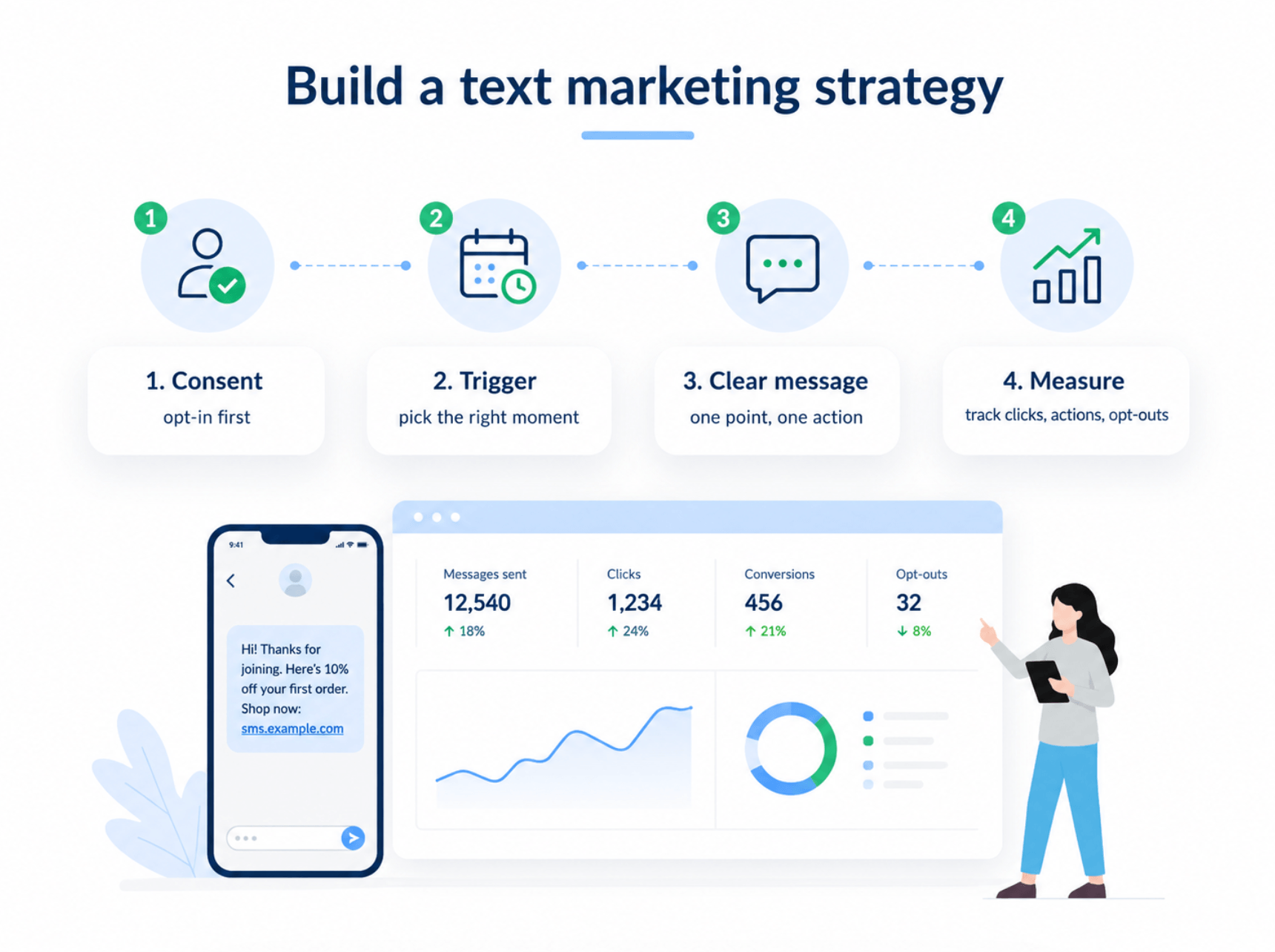
A text marketing strategy should answer four questions before the first campaign goes live:
- Who has agreed to receive messages?
- Which moments deserve a text?
- What action should each message support?
- How will you measure whether it helped?
The answers are more important than selecting the best SMS marketing software on a comparison page.
Start with consent, not a contact upload
An opt-in is not a loose suggestion. It is the foundation of a responsible SMS marketing program. People should know who will text them, what kind of messages they can expect and how to stop receiving them. Keep a record of how each contact opted in. Respect opt-out requests quickly.
Rules vary by country, carrier and industry. The sensible baseline is simple: obtain clear consent, keep records, identify your brand and make opting out easy. Do not add phone numbers from an old CRM export just because someone bought from you years ago. A contact list is not automatically an SMS list. SMSAPI’s SMS marketing guide covers consent, database building and the relationship between message relevance and campaign performance.
Define the message types before you automate
Create categories before you create campaigns.
| Message type | Typical trigger | Main purpose | Text message example |
| Welcome | New opt-in | Set expectations | Thanks for joining. Expect early access and useful updates. |
| Transactional | Order or account event | Confirm or inform | Your order has shipped. |
| Reminder | Upcoming date | Reduce missed action | Your appointment is tomorrow. |
| Product alert | Stock or price change | Bring back intent | Your saved item is back. |
| Promotional | Relevant offer | Encourage purchase | Free delivery ends Sunday. |
| Reactivation | Inactivity period | Reconnect with context | Your usual product is available again. |
This structure makes it easier to see when you are using text messages as service and when you are using them for sales.
It also makes it easier to automate the right campaigns. SMSAPI’s SMS gateway gives teams a web interface for campaign management, while the SMS API supports more custom, event-based communication.
Segment before you send
A message can be short and still be irrelevant.
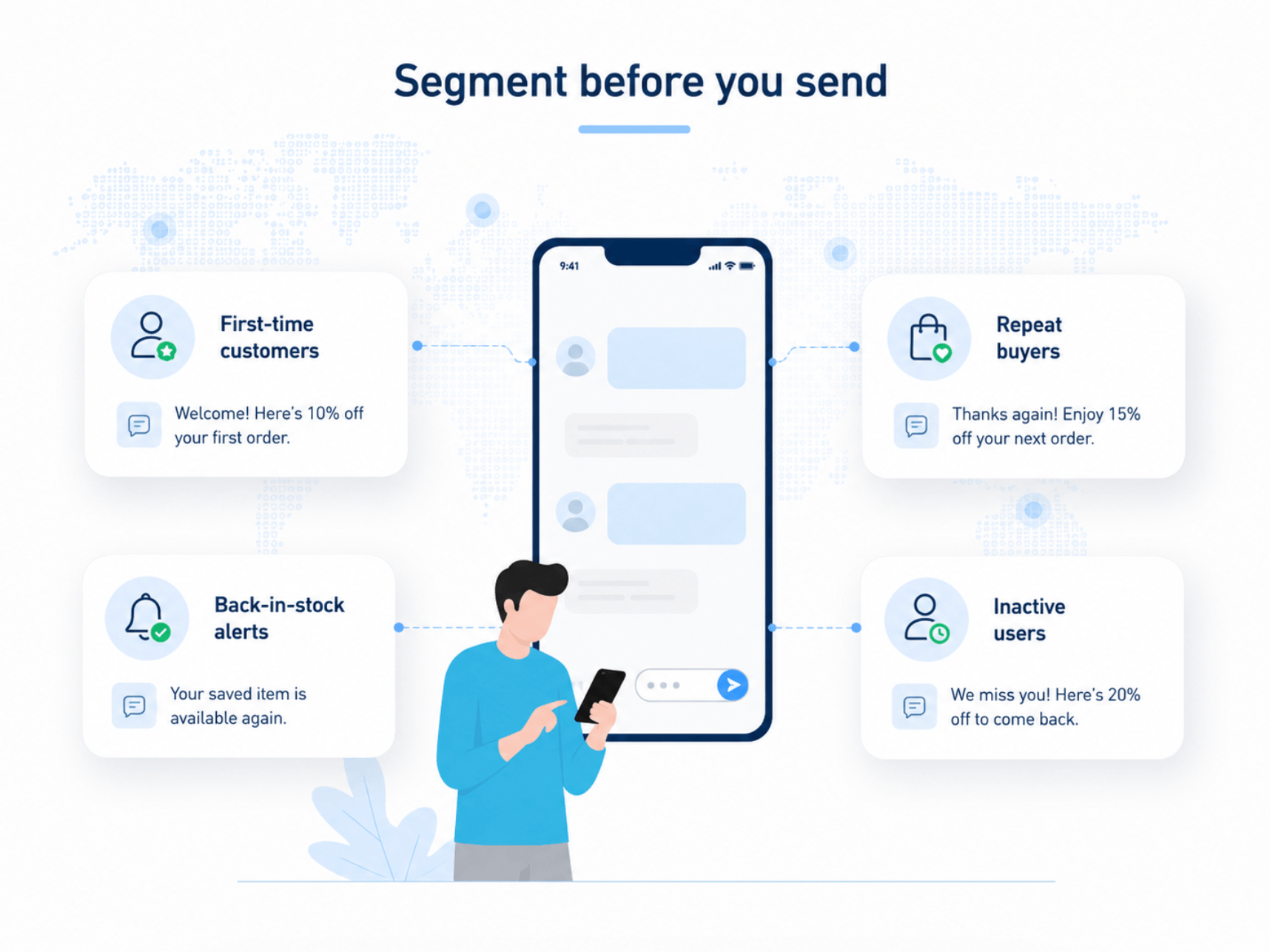
Segment by what the recipient has done, not only by demographics!
How to segment text messages?
- first-time customers
- repeat buyers
- customers with an upcoming appointment
- people waiting for a restock
- customers who have not purchased for a set period
- customers who bought from a specific product category
- high-value customers
- people who clicked a previous SMS but did not complete the action
Segmentation makes targeted messaging easier. It also reduces the temptation to send a mass text to everyone every time there is a sale. A small business can begin with two or three segments. You do not need an elaborate data model on day one. The important part is having a reason for each group to receive a different SMS message.
How to write text messages people will read
The message length is limited, which can be an advantage. It forces clarity.
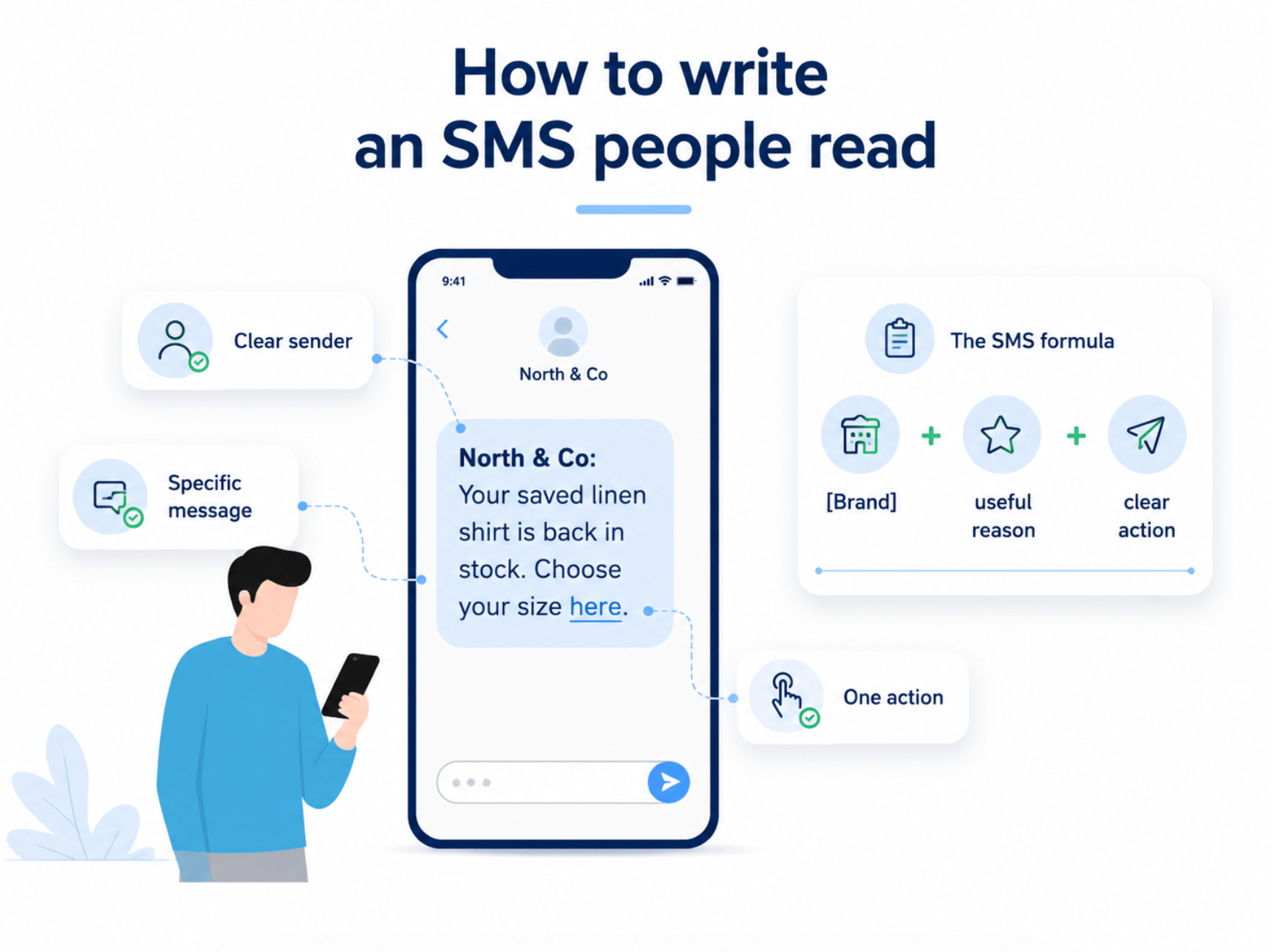
A strong marketing message usually has:
- a clear sender
- one useful point
- one action
- one link, if needed
- a simple way to opt out when required
Here is a simple structure: [Brand]: [specific reason to care]. [clear action]: [link]
For example:
North & Co: Your saved linen shirt is back in stock. Choose your size before it sells out: [link]
Or:
Studio 34: Your session is tomorrow at 18:00. Need to reschedule? Use this link: [link]
The message does not need clever wordplay – it needs to be immediately understandable.
Keep the call to action honest
A call to action should match the message.
What are the good examples of CTA?
- Shop the collection
- Confirm your booking
- View your order
- Choose a new time
- Complete your registration
- See available sizes
- Renew your plan
Avoid making every message sound urgent. A recipient who sees “last chance” every week will stop believing it.
Use a branded sender when available
A branded Sender ID can help recipients recognise who has contacted them before they open the message. That can improve trust, especially for service updates and recurring campaigns.
SMSAPI supports branded sender names where local regulations and network rules allow it. Their guide to sending branded SMS with Sender ID explains how sender names work and why they are useful for recognisability.
Do not rely on a sender name alone to explain why the person received the text. The message should still make the context clear.
Do not force a link into every SMS
A link is useful when it takes the recipient to a specific next step. It is not useful when it sends them to a generic homepage.
You may not need a link for a delivery update, a short reminder or a message asking a customer to reply. If you do add one, keep it recognisable and trackable. Use UTM parameters for SMS campaigns to see which message, audience and offer created traffic or conversion in Google Analytics.
How often should you send SMS marketing messages?
There is no universal answer. Frequency depends on consent expectations, purchase cycle and the value of each message.
A grocery delivery service may have a reason to send weekly offers. A furniture retailer may have no reason to contact the same customer that often. A healthcare provider should keep reminders distinct from promotional messages.
A good rule: each SMS should pass a simple test. Would the recipient understand why they received this today? If the answer is unclear, the message probably needs more context or should not be sent.
Track complaints, opt-outs, delivery rates and engagement. If a campaign gets clicks but also triggers a rise in opt-outs, the offer may not be worth the long-term cost. SMSAPI’s SMS marketing audit guide can help teams review frequency, targeting, sender recognition and campaign quality before audience fatigue becomes a problem.
How to measure SMS marketing performance?
Marketing metrics should reflect the goal of the campaign.
- For a promotional campaign, look at clicks, purchases, revenue and repeat engagement.
- For an appointment reminder, look at attendance and reschedule rate.
- For a delivery update, customer service contacts may be more useful than clicks.
- For a reactivation campaign, compare the cost of the campaign with the number of customers who return.
What are the useful SMS marketing metrics?
- delivered messages
- failed messages
- click-through rate
- conversion rate
- revenue per message
- unsubscribe or opt-out rate
- repeat purchase rate
- appointment attendance
- time to action after the message
- campaign lift compared with a holdout group
Do not focus only on the number of text messages sent. A smaller campaign that reaches the right people can outperform a larger one that creates little value. As reporting becomes more complex, AI insights can help teams explore campaign data through natural-language questions, identify patterns and turn performance results into clearer next steps.
For campaigns with links, UTM tracking makes it easier to compare SMS against email marketing, paid social and other channels.
A practical 30-day text marketing plan
Here is a simple example for a small ecommerce business.
Week 1: build the foundation
Set up an opt-in form. Define the welcome message. Create a clear unsubscribe process. Decide which customer actions will trigger a message.
Do not start with several text campaigns. Begin with the basics. For technical teams, SMSAPI’s guide to sending SMS through an API is a useful first step when setting up automated triggers.
Week 2: launch the first automated messages
Create a welcome message, an order confirmation and a delivery update.
These messages help establish the channel as useful. They also give the team a chance to check message delivery, sender identity and link tracking. Teams that prefer a lighter setup can also explore three ways to send SMS: through the API, customer portal or mobile app.
Week 3: add one marketing campaign
Choose one relevant promotion. Affiliate publishers should be equally selective about the affiliate marketing products they promote. Match the offer to the interests and previous behaviour of the subscriber instead of rotating unrelated deals through the same SMS list.
For example, send a restock alert to customers who asked for it, or offer free delivery to a segment that recently viewed a category but did not purchase. Keep the campaign focused. Do not send a mass text to your entire marketing list just to test the system.
For ecommerce stores running Shopify, SMSAPI’s Shopify SMS plugin guide includes examples of abandoned checkout and segmentation automation.
Week 4: review and improve
Review performance. Did people click? Did they buy? Did the message lead to replies, complaints or opt-outs?
Check the messages that performed best. Look for the reason they worked: timing, relevance, offer, segment or the fact that the communication solved a practical problem. Then use that insight to plan the next month.
Choosing an SMS marketing platform
The best SMS marketing software depends on your use case.
A simple marketing platform may be enough for small businesses that need scheduled text campaigns and basic contact management. A more flexible SMS marketing service may be better for teams that need API access, transactional messages, integrations or custom automation. Some teams go a step further and create their own campaign dashboards, customer portals or internal applications using AI SaaS building tools, then connect them to an SMS API for message delivery.
What to look for when comparing SMS gateways?
- clear consent and opt-out handling
- contact segmentation
- bulk SMS capability
- API access
- integrations with CRM and ecommerce tools
- branded sender options
- campaign reporting
- link tracking
- reliable delivery across the markets you serve
- a free trial that lets you test the setup before committing
People often search for a marketing platform when they need a straightforward way to launch text campaigns. That can be useful for basic outreach. But businesses with more complex customer journeys should also consider whether the tool can support transactional messaging, triggered automations and data from other systems.
SMSAPI provides a free trial, bulk SMS tools, an API and integrations that can support both marketing and operational communication. Our pricing page explains the prepaid model for teams that need to estimate campaign costs before scaling.
Test SMSAPI
Create a free account at SMSAPI and test the professional SMS gateway for companies.
Text marketing best practices to keep
A final checklist for every campaign:
- send only to people who opted in
- identify the brand clearly
- give the recipient one reason to care
- use targeted messaging where possible
- keep the copy short
- make the CTA easy to understand
- check the destination page before sending
- stop messages after an opt-out
- track performance beyond click-through rate
- review frequency across the full customer journey
Text marketing can be powerful because it is immediate. That also means every message has to respect the recipient’s attention.
The strongest SMS marketing campaigns do not try to be everywhere at once. They show up at the moments where a short, timely message can genuinely help the customer take the next step. For more ecommerce-specific applications, see our guide to recovering abandoned carts with SMS.